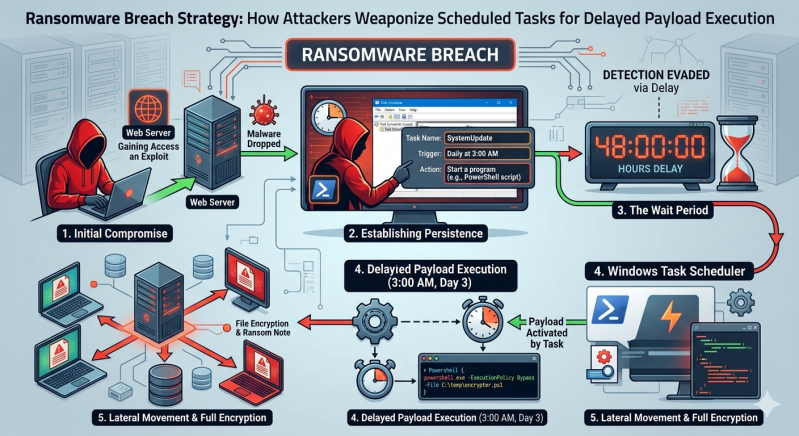
Threat actors continuously refine their methodologies to evade detection and maximize the impact of their campaigns. A notable shift in recent years involves moving away from the immediate detonation of malicious payloads. Instead, adversaries are establishing persistent, stealthy footholds within compromised networks, waiting for the optimal moment to strike.
A critical technique observed in many recent ransomware breaches is the abuse of native operating system scheduling tools. By weaponizing scheduled tasks, attackers can dictate exactly when their encryption routines execute, often timing them for weekends, holidays, or periods of low administrative monitoring. This calculated delay disrupts standard incident response protocols and severely limits the defensive capabilities of targeted organizations.
Understanding the mechanics of delayed payload execution is vital for security teams. As highlighted in security news daily, relying solely on perimeter defenses is no longer sufficient. Security practitioners must analyze the internal behaviors of threat actors, particularly how they leverage legitimate administrative tools to facilitate catastrophic network disruptions.
The Mechanics of Delayed Execution
To execute a successful ransomware breach, attackers must ensure their encryption software runs with high privileges and without interference from endpoint security products. Scheduled tasks provide an ideal vehicle for this requirement.
Evading Immediate Detection
Endpoint Detection and Response (EDR) solutions are highly effective at identifying the immediate, synchronous execution of known malicious binaries. When an attacker drops a payload and executes it directly, the parent-child process relationship is highly visible. The EDR can quickly analyze the behavior, flag the anomaly, and terminate the process before significant damage occurs.
By creating a scheduled task, the attacker breaks this visible execution chain. The payload is not executed by the initial malicious script or dropped executable. Instead, the Windows Task Scheduler service (svchost.exe) eventually triggers the payload at the designated time. This asynchronous execution model often bypasses basic behavioral rules, as the operating system itself is technically launching the executable.
Leveraging Windows Task Scheduler
The Windows operating system includes robust utilities for task scheduling, primarily managed through the Task Scheduler graphical interface, the schtasks.exe command-line utility, or the underlying Component Object Model (COM) interfaces. Attackers heavily favor schtasks.exe due to its availability on all modern Windows endpoints and its scriptable nature.
A typical command might look like this: schtasks /create /tn "SystemUpdate" /tr "C:\Windows\Temp\payload.exe" /sc once /st 02:00 /ru SYSTEM.
This command creates a task disguised as a routine system update, points to a payload hidden in a temporary directory, sets it to run once at 2:00 AM, and executes it with the highest possible system privileges. Because network administrators frequently use schtasks.exe for legitimate maintenance, its presence in command-line logs does not always trigger immediate alarms.
How a Ransomware Breach Unfolds via Scheduled Tasks?
The weaponization of scheduled tasks does not occur in a vacuum. It is a specific phase within the broader attack lifecycle, requiring prior network penetration and privilege escalation.
Initial Access and Privilege Escalation
Before an attacker can schedule a high-privileged task, they must first gain access to the target environment. This is typically achieved through phishing, exploiting vulnerable public-facing applications, or purchasing compromised credentials from initial access brokers.
Once inside, the attacker focuses on lateral movement and privilege escalation. Creating a scheduled task that executes with SYSTEM level privileges requires administrative rights on the target machine. Attackers will dump credentials, exploit local vulnerabilities, or manipulate access tokens to acquire the necessary permissions.
Task Creation and Obfuscation
With administrative access secured, the attacker drops the ransomware payload onto the file system. To maximize the chances of success, the payload is often obfuscated or encrypted, and placed in obscure directories.
The attacker then configures the scheduled task. To maintain stealth, they will frequently employ deceptive naming conventions, mirroring legitimate Microsoft or third-party software tasks. They may also configure the task to delete itself immediately upon execution, removing the most obvious forensic artifact of the launch mechanism. The network is then left waiting for the trigger condition to be met, at which point the ransomware breach fully materializes.
Mitigating the Threat of Scheduled Task Abuse
Defending against the abuse of native operating system tools—often referred to as "Living off the Land" (LotL) techniques—requires a proactive, defense-in-depth strategy. Organizations must assume that initial access will occur and focus on detecting post-compromise behaviors.
Proactive Monitoring and Alerting
Security Operations Centers (SOC) must implement robust monitoring for process creation events, specifically focusing on schtasks.exe and PowerShell scripts interacting with scheduled task COM objects.
Defenders should establish a baseline of normal scheduled task activity within their environment. Any deviation from this baseline—such as tasks created by unexpected user accounts, tasks executing from temporary directories, or tasks scheduled to run during off-hours—should trigger immediate investigation. Centralized logging tools and Security Information and Event Management (SIEM) platforms are essential for aggregating and analyzing these events across the entire network.
Principle of Least Privilege
Restricting the ability to create and modify scheduled tasks is a fundamental defensive measure. In the context of security breach news, implementing the Principle of Least Privilege (PoLP) ensures that standard users do not have administrative rights on their local machines.
Furthermore, network administrators should utilize dedicated, heavily monitored accounts for system maintenance. By limiting the number of accounts capable of creating system-level tasks, organizations significantly reduce the attack surface available to threat actors attempting to stage a delayed ransomware payload.
Strengthening Your Defenses Against Advanced Tactics
The use of scheduled tasks for delayed payload execution illustrates the sophisticated, calculated nature of modern cyber threats. Attackers are intimately familiar with the operating systems they target and continuously find ways to turn legitimate administrative tools against their victims.
To prevent a devastating ransomware breach, organizations must evolve beyond traditional signature-based defenses. By implementing strict privilege controls, establishing baseline behavioral metrics, and rigorously monitoring for anomalous task scheduling, security teams can detect these stealthy persistence mechanisms before the encryption routine ever begins. Continuous education and staying informed regarding the latest adversarial techniques remain the strongest foundation for a resilient security posture.
Add comment
Comments