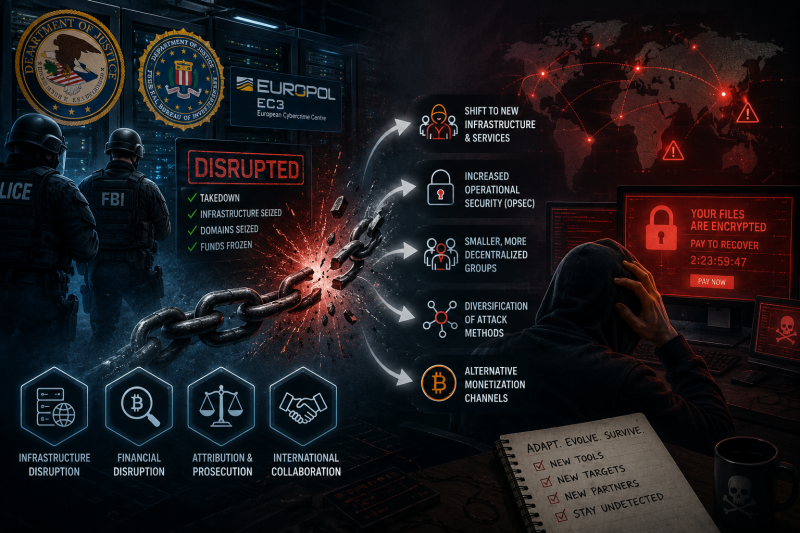
Over the last several years, ransomware has remained one of the most disruptive cyber threats affecting businesses, governments, healthcare providers, educational institutions, and critical infrastructure operators worldwide. While ransomware groups continue to generate substantial financial gains through extortion campaigns, recent law enforcement actions have begun reshaping the cybercriminal landscape. Coordinated international operations targeting ransomware infrastructure, cryptocurrency laundering networks, affiliate programs, and command-and-control systems are creating new challenges for threat actors.
Recent Ransomware Review discussions have increasingly focused on how these enforcement efforts are changing attacker strategies. Rather than eliminating ransomware entirely, law enforcement disruptions are forcing cybercriminal groups to adapt their tactics, reorganize operational structures, and explore alternative methods for maintaining profitability. At the same time, ongoing security breach news reports reveal that many organizations remain vulnerable despite increased enforcement activity.
Understanding how threat actors respond to law enforcement pressure provides valuable insight into the future evolution of ransomware campaigns and helps organizations prepare for emerging threats.
The Growing Impact of Coordinated Enforcement Efforts
Historically, ransomware groups operated with relatively little interference, allowing them to establish sophisticated business models that included affiliate recruitment, technical support services, and profit-sharing arrangements.
However, international cooperation among cybersecurity agencies, intelligence organizations, and law enforcement bodies has increased significantly in recent years. Authorities have targeted infrastructure used by ransomware groups, seized servers, disrupted communication channels, and frozen cryptocurrency assets linked to criminal operations.
Many recent Ransomware Review analyses suggest that these actions have created operational uncertainty for threat actors. Criminal groups that once operated openly on underground forums now face increased risks of exposure and disruption.
At the same time, security breach news continues to demonstrate that even successful enforcement actions do not eliminate the broader ransomware ecosystem. Instead, they often trigger behavioral shifts among attackers seeking new ways to avoid detection.
Fragmentation of Established Ransomware Groups
One noticeable consequence of law enforcement pressure is the fragmentation of larger ransomware organizations.
When major ransomware groups experience infrastructure seizures or arrests, their operations often splinter into smaller independent teams. Former affiliates may establish new groups, develop modified ransomware variants, or partner with other criminal networks.
Recent Ransomware Review reports indicate that this fragmentation creates a more decentralized threat landscape. Rather than facing a small number of highly visible ransomware operations, defenders must now monitor numerous smaller groups with varying capabilities.
This decentralization can make attribution more difficult and complicate threat intelligence efforts. Smaller groups may operate with less predictable structures and employ different attack methodologies.
Many security breach news investigations have highlighted incidents involving newly emerged ransomware brands that appeared shortly after disruptions affected larger criminal organizations.
Increased Operational Secrecy Among Threat Actors
Law enforcement disruptions have also encouraged ransomware operators to adopt more secretive practices.
Previously, some ransomware groups openly promoted their services, recruitment opportunities, and data leak platforms within underground communities. Increased enforcement activity has caused many operators to reduce public visibility and restrict communications.
Modern Ransomware Review assessments frequently note that threat actors are becoming more selective about affiliate recruitment and access controls. Criminal organizations increasingly rely on trusted relationships rather than broad public advertising.
Additionally, ransomware operators are investing greater effort in operational security measures designed to conceal infrastructure and communication channels.
According to ongoing security breach news coverage, these adaptations make it more challenging for investigators to infiltrate criminal networks and gather intelligence regarding planned attacks.
The result is a threat landscape characterized by greater secrecy and reduced transparency within cybercriminal communities.
Shifts Toward Faster Attack Execution
Another significant behavioral change involves the speed of ransomware operations.
Threat actors recognize that extended dwell times increase the likelihood of detection and intervention. As law enforcement agencies improve intelligence-sharing capabilities, attackers face greater pressure to execute campaigns quickly.
Recent Ransomware Review analyses suggest that many groups are shortening reconnaissance phases and accelerating deployment timelines. Rather than spending weeks inside a target environment, attackers increasingly prioritize rapid execution.
Automated tools, credential harvesting techniques, and streamlined attack workflows enable cybercriminals to move from initial access to ransomware deployment more efficiently.
Several security breach news reports have documented incidents where organizations experienced encryption activity within hours of compromise rather than days or weeks.
This trend underscores the importance of rapid detection and response capabilities within modern cybersecurity programs.
Evolution of Extortion Strategies
Law enforcement pressure is also influencing the evolution of ransomware extortion tactics.
Traditional ransomware operations focused primarily on encrypting systems and demanding payment for decryption keys. However, increased disruptions have encouraged threat actors to diversify their revenue models.
Many modern Ransomware Review reports describe campaigns involving multiple layers of extortion. Attackers may steal sensitive data, threaten public disclosure, target business partners, or apply reputational pressure in addition to encryption activities.
These multi-extortion approaches provide alternative leverage if victims refuse to negotiate or if technical disruptions affect ransomware deployment.
Ongoing security breach news coverage frequently highlights incidents where organizations faced significant challenges due to data theft even when encryption impacts were limited.
Threat actors continue adapting extortion techniques to maximize profitability despite increased operational risks.
The Role of Cryptocurrency Monitoring
Cryptocurrency has long played a central role in ransomware operations by facilitating anonymous or pseudonymous financial transactions.
Law enforcement agencies have increasingly focused on tracking cryptocurrency flows associated with ransomware payments. Advanced blockchain analysis techniques now enable investigators to identify suspicious transactions and disrupt laundering activities.
Recent Ransomware Review discussions indicate that threat actors are responding by experimenting with alternative payment methods, complex laundering chains, and decentralized financial services.
Some groups attempt to obscure transaction histories through multiple intermediaries, while others explore emerging digital assets with enhanced privacy features.
Meanwhile, security breach news reports demonstrate that financial tracing remains one of the most effective tools available to investigators seeking to dismantle ransomware ecosystems.
The ongoing contest between criminal innovation and investigative capabilities continues shaping ransomware economics.
Defensive Opportunities for Organizations
Although ransomware remains a serious threat, law enforcement disruptions create opportunities for organizations to strengthen defenses.
Threat actor adaptation often introduces operational complexity, communication challenges, and infrastructure instability within criminal networks. These conditions can generate intelligence opportunities that defenders can use to improve detection capabilities.
Many Ransomware Review experts recommend leveraging threat intelligence feeds, behavioral monitoring systems, and incident response planning to capitalize on emerging visibility into attacker activities.
Organizations should also focus on fundamental cybersecurity practices, including strong authentication controls, endpoint monitoring, employee awareness training, and network segmentation.
Numerous security breach news investigations reveal that many successful ransomware incidents still originate from preventable weaknesses such as stolen credentials, unpatched systems, or phishing attacks.
Strengthening basic security controls remains one of the most effective methods for reducing ransomware risk.
Looking Ahead at the Future of Ransomware
The future ransomware landscape will likely continue evolving as law enforcement agencies expand international cooperation and improve disruption capabilities.
Threat actors will undoubtedly adapt by developing new operational models, experimenting with alternative extortion techniques, and investing in more sophisticated evasion strategies.
Recent Ransomware Review discussions suggest that ransomware groups may increasingly resemble flexible criminal networks rather than centralized organizations. Decentralization, automation, and operational secrecy are expected to remain dominant trends.
At the same time, security breach news consistently demonstrates that collaboration among governments, private-sector organizations, and cybersecurity researchers can significantly disrupt criminal activities and reduce attacker effectiveness.
The ongoing interaction between enforcement efforts and criminal adaptation will continue shaping the cybersecurity landscape for years to come.
Conclusion
Law enforcement disruptions are having a measurable impact on ransomware operations, influencing how threat actors organize, communicate, execute attacks, and generate revenue. As highlighted in recent Ransomware Review analyses, cybercriminal groups are responding through fragmentation, increased secrecy, accelerated attack timelines, and evolving extortion strategies.
While these adaptations present new challenges, ongoing security breach news coverage also demonstrates the value of coordinated enforcement efforts in disrupting criminal ecosystems and creating opportunities for defenders. Organizations that combine strong cybersecurity fundamentals with proactive threat intelligence and rapid response capabilities will be better positioned to withstand the evolving ransomware threat landscape and reduce the likelihood of becoming future victims.
Add comment
Comments